
IAH Airport Guide Complete for 2026 Travelers at George Bush Intercontinental
This IAH airport guide complete walkthrough covers everything a traveler needs to know about George Bush Intercontinental Airport, from terminal layouts and airline placements to parking rates, lounges, dining, security wait times, and ground transportation. IAH is the primary international gateway for the Houston region and one of the ten busiest airports in the United States, handling more than 45 million passengers a year. Local operators like Pro Ride Limo, which has been running Houston airport transfers since 2015, know how quickly the layout confuses first-time visitors. The information below is written to remove that confusion before a flight lands and before the drive to the terminal begins.
Quick Facts About George Bush Intercontinental Airport
George Bush Intercontinental Airport (IAH) is Houston's primary long-haul hub, spread across five terminals labeled A through E, located about 23 miles north of Downtown Houston in Harris County, Texas. The airport opened in 1969 as Houston Intercontinental and was renamed in 1997 to honor President George H.W. Bush. United Airlines operates its second-largest hub here, using Terminals B, C, and E for the majority of its flights.
The airport code IAH stands for Intercontinental Airport Houston. The IATA identifier is IAH and the ICAO code is KIAH. The airport property covers roughly 10,000 acres, making it one of the largest airfields in North America by land area. Five runways handle a mix of transcontinental, transatlantic, transpacific, and short-haul Latin American traffic, with nonstop service to more than 180 destinations worldwide.
| Airport code | IAH |
|---|---|
| Address | 2800 N Terminal Rd, Houston, TX 77032 |
| Distance from Downtown Houston | 23 miles north |
| Number of terminals | 5 (A, B, C, D, E) |
| Airlines served | 25+ passenger carriers |
| Annual passengers | 45+ million |
| Primary hub airline | United Airlines |
| International destinations | 70+ cities across 25+ countries |
Where Is IAH Located Relative to Houston Neighborhoods
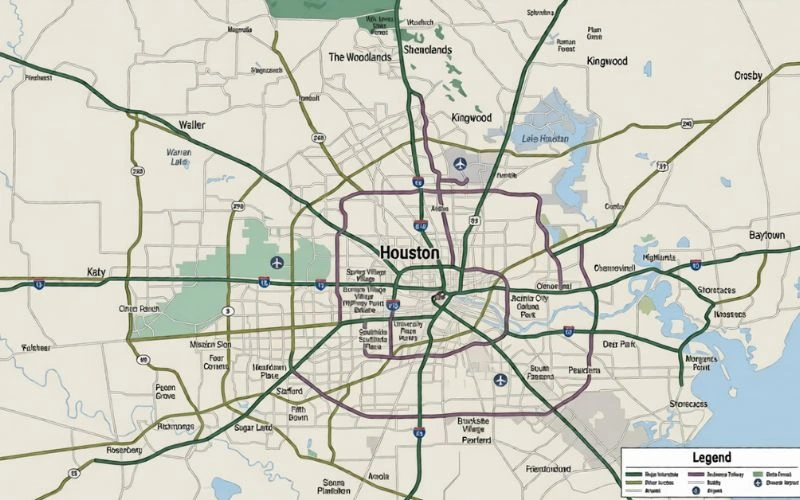
George Bush Intercontinental Airport sits at 2800 N Terminal Road, roughly 23 miles north of Downtown Houston and about 30 minutes by car outside peak traffic. The airport is bordered by Beltway 8 to the south, Interstate 45 to the west, and U.S. Highway 59 to the east, giving drivers three main approach routes depending on where they are coming from.
Travelers from Downtown Houston, Midtown, or the Museum District usually take I-45 North or the Hardy Toll Road. Passengers heading in from the Galleria, River Oaks, or the Energy Corridor typically use Beltway 8 East, while those coming from Sugar Land, Katy, or Missouri City run Beltway 8 North across Highway 59. The Woodlands and Spring travelers take I-45 South, and passengers from Kingwood, Humble, or Atascocita approach through U.S. 59 South. The airport's proximity to Highway 59, the Hardy Toll Road, and I-45 means Houston's suburbs feed traffic in from multiple directions, and knowing which route matches which zone saves real time on early morning departures.
The Five Terminals at IAH Explained in One Place
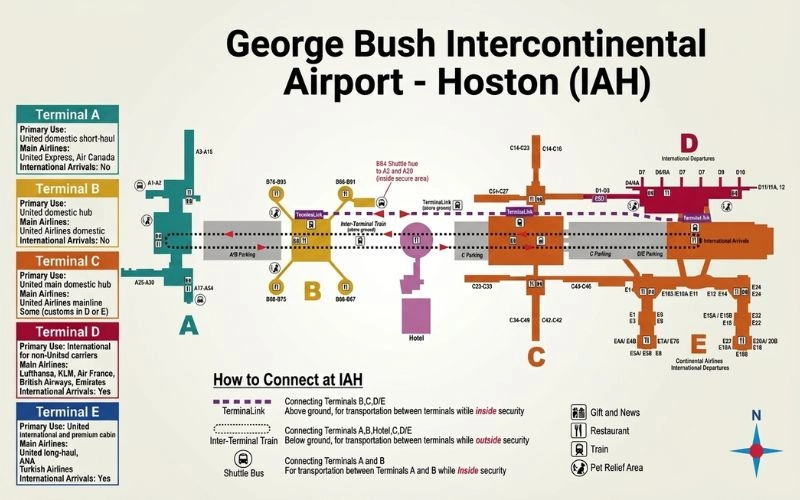
IAH is organized into five terminals arranged in a rough semicircle around the central airfield, all connected post-security by the Skyway automated people mover and pre-security by the TerminaLink underground train. Each terminal handles a distinct mix of airlines and destinations, so knowing the layout before arrival prevents the long walks that first-timers often complain about.
Terminals A, B, C, and E cluster on the west and central sides of the airport, while Terminal D sits slightly separate as the historical international terminal for non-United carriers. Federal Inspection Services (customs and immigration) operate in both Terminal D and Terminal E, which is why some international arrivals collect bags in one terminal even if their airline check-in is in another.
| Terminal | Primary Use | Main Airlines | International Arrivals |
|---|---|---|---|
| Terminal A | United domestic short-haul | United Express, Air Canada | No |
| Terminal B | United domestic hub | United Airlines domestic | No |
| Terminal C | United main domestic hub | United Airlines mainline | Some (customs in D or E) |
| Terminal D | International for non-United carriers | Lufthansa, KLM, Air France, British Airways, Emirates | Yes |
| Terminal E | United international and premium cabin | United long-haul, ANA, Turkish Airlines | Yes |
Terminal A Handles United Domestic West Concourse Flights
Terminal A at IAH is the westernmost terminal and primarily services United Express regional flights along with a few partner carriers like Air Canada. The terminal has two concourses labeled A North and A South, with gates numbered A1 through A31, and ticketing is on the upper level while baggage claim and pickup sit on the lower curbside level.
Because Terminal A leans heavily on regional aircraft and short-haul city pairs, boarding often happens at ground-level jet bridges or bus gates, which surprises passengers used to standard jetways. Rental car pickup for Terminal A arrivals runs from the ground transportation curb, and the walk to the Skyway or subway train inside security is one of the shorter connections in the airport. For anyone catching a United Express flight to Austin, San Antonio, New Orleans, or Monterrey, Terminal A is usually the boarding terminal.
Terminal B Serves United Central Domestic Hub Operations
Terminal B is the middle terminal in the IAH complex and functions as a secondary United Airlines domestic hub, with gates numbered B1 through B34 handling everything from Dallas Fort Worth turns to Chicago O'Hare mainline routes. Ticketing counters open by 4 a.m. for the earliest departures, and the terminal has undergone gradual modernization since the 2020s.
The terminal shares the central pier layout with Terminal C, which means passengers moving between B and C can often walk between them post-security without needing the Skyway train. Concessions in Terminal B include Yao Restaurant, Landrys Seafood, Pappasitos, Ruby's Diner, and a Starbucks near the center of the concourse. TSA PreCheck and CLEAR lanes both operate at Terminal B security, and average wait times run 8 to 15 minutes at PreCheck and 20 to 35 minutes at standard lanes during peak morning departures.
Terminal C Is the Main United Hub for Domestic Flights
Terminal C at IAH is the heart of United's Houston operation, split into Terminal C North and Terminal C South, with roughly 40 gates that handle the largest share of domestic mainline flights across the airport. This is where most United passengers heading to Newark, San Francisco, Los Angeles, Denver, and other major U.S. cities board, and where United connects most of its long-haul international traffic through domestic feeders.
Terminal C South opened as a modernized concourse and includes the United Polaris Lounge, the United Club, several sit-down restaurants like Ember Steakhouse and Kaufman's Tavern, and a range of local Texas food brands. Baggage claim carousels in Terminal C are numbered by flight arrival area, and the meet and greet area for arriving passengers sits between Terminal C and Terminal E on the lower curbside level. Because Terminal C handles high domestic volume, curbside pickup congestion peaks between 4 p.m. and 7 p.m. on weekdays.
Terminal D Handles International Flights for Non-United Carriers
Terminal D at George Bush Intercontinental is the historic international terminal, handling long-haul flights from carriers outside the United Airlines and Star Alliance family, including Lufthansa, Air France, KLM, British Airways, Emirates, Qatar Airways, EVA Air, and Aeromexico. Gates are numbered D1 through D12, and the Federal Inspection Services (FIS) hall inside Terminal D is where non-United international passengers clear customs and immigration.
The terminal has a distinctive rounded architecture and includes lounges like the Air France Lounge, KLM Crown Lounge, British Airways Lounge, and The Centurion Lounge (American Express). Duty free shopping runs from the central atrium down each concourse, and dining includes Cru Wine Bar, Hugo's, and a rotating set of Houston-based food brands. Arriving international passengers exit customs into the greeting hall on the lower level, where flat-rate chauffeurs and taxi lanes are separated from ride-share pickup zones by dedicated island signage. Passengers connecting from a non-United international flight to a United domestic flight typically re-check bags and clear TSA again after customs.
Terminal E Covers United International and Premium Cabin Departures
Terminal E at IAH is United Airlines' international hub within the airport, handling most long-haul departures to Europe, Asia, South America, and Africa. Gates are numbered E1 through E24, and this is the primary base for United Polaris business class service, meaning premium cabin travelers heading to Frankfurt, London, Tokyo, Amsterdam, São Paulo, and Sydney typically depart from Terminal E.
The United Polaris Lounge in Terminal E is considered one of the top business class lounges in the United Airlines global network, with a sit-down dining room, private day suites, showers, and a dedicated bar. The main United Club in Terminal E serves both Polaris and standard club members. Arriving international passengers on United flights clear customs and immigration in Terminal E's FIS hall and exit into a greeting area at the far east end of the airport. The distance between Terminal E arrivals and Terminals A, B, or C for connecting flights is significant, and the Skyway train is the fastest route inside security.
Which Airlines Operate at IAH George Bush Intercontinental
More than 25 passenger airlines currently operate scheduled service at IAH, spanning U.S. mainline carriers, low-cost operators, and major international flag carriers. United Airlines operates roughly 78 percent of all seats out of IAH, followed by Southwest, American, Delta, Spirit, and Frontier for domestic service, with a growing list of international operators serving Europe, Asia, Latin America, and the Middle East.
The Star Alliance presence at IAH is one of the strongest at any U.S. airport, with United joined by Lufthansa, Air Canada, ANA, Turkish Airlines, Avianca, EVA Air, and Copa Airlines. SkyTeam is represented through Air France, KLM, Aeromexico, and Delta, while Oneworld has British Airways, Qatar Airways, American, and Iberia. Emirates operates its own daily wide-body service to Dubai from Terminal D, and Etihad and Singapore Airlines codeshare through partner metal.
Common airline placements at IAH:
- United Airlines mainline domestic departs from Terminals B and C
- United Airlines international long-haul departs from Terminal E
- United Express regional flights use Terminal A
- Air Canada uses Terminal A for Toronto and Montreal routes
- Lufthansa, Air France, KLM, British Airways, and Emirates operate from Terminal D
- Southwest and Spirit hold small operations, mostly using Terminal A and D gates
- Aeromexico and Volaris cover Mexico City, Guadalajara, and Monterrey from Terminal D
Getting Between Terminals Using Skyway Train and Subway
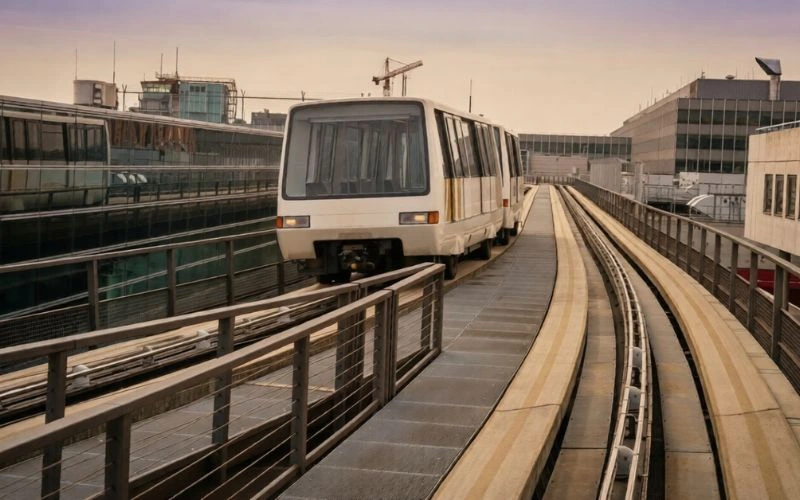
Two systems move passengers between IAH terminals. The Skyway is an elevated automated people mover that runs inside the security perimeter, connecting Terminals A, B, C, and E in a continuous loop. The TerminaLink underground subway runs pre-security between Terminals B, C, D, and E for passengers who have not yet cleared TSA or who are re-entering the airport landside after arrival.
The Skyway is the fastest option for connecting passengers already inside security and typically takes 2 to 4 minutes between stations. It operates 24 hours a day and departs every few minutes, with signage inside each terminal directing passengers to the "Skyway to gates" corridor. The TerminaLink subway is the correct choice for passengers who need to re-clear security in a different terminal, and it also serves airport employees moving between check-in areas. For international connecting passengers arriving in Terminal D or E, the walking distance to Terminals A or B can exceed 20 minutes on foot, which makes the Skyway the practical route between concourses. Passengers arriving late for a connection should still budget 30 minutes minimum between gates.
Parking Options at IAH and What Each Costs
IAH offers five official parking options operated by the Houston Airport System, plus a large ecosystem of off-airport lots along JFK Boulevard and Hardy Toll Road. Rates and shuttle times vary considerably, and picking the right lot depends on how long the vehicle stays, how close the traveler wants to be to their terminal, and whether they need covered parking.
The main on-airport options are Terminal Garage parking, Ecopark 1, Ecopark 2, and cell phone waiting lots. Terminal Garage parking sits directly across from Terminals A, B, C, D, and E with covered spaces and a short walk to check-in. Ecopark and Ecopark 2 are surface lots with continuous shuttle service running every 5 to 10 minutes and take about 12 to 15 minutes to reach the terminals.
| Parking Option | Daily Rate (approx) | Distance to Terminal | Best For |
|---|---|---|---|
| Terminal Garage | $22 to $28 | Steps from check-in | Same-day and short trips |
| Ecopark 1 | $8 to $10 | 10 to 15 min shuttle | Multi-day trips |
| Ecopark 2 | $8 to $10 | 10 to 15 min shuttle | Multi-day trips |
| Hourly Garage | $3 to $6 per hour | Steps from check-in | Pickups and drop-offs |
| Cell Phone Lot | Free | 5 min drive to terminal | Waiting to pick up a passenger |
The cell phone lot is located on JFK Boulevard just south of the terminals and gives drivers a free waiting area until an arriving passenger sends a curbside pickup message. Off-airport lots along JFK Boulevard often run $7 to $9 a day and are popular for week-long trips.
Lounges at IAH Worth Visiting Before a Flight
IAH has a strong lounge network across all five terminals, driven mainly by United's Polaris and Club footprint but supplemented by international carrier lounges in Terminal D and independent lounges like The Centurion. Lounge access rules vary by carrier and membership program, and the best lounge often depends on the departure terminal.
The United Polaris Lounge in Terminal E is the flagship, open only to same-day international Polaris business class passengers and includes a full sit-down restaurant, private day suites, showers, and quiet work areas. United Club locations sit in Terminals B, C, and E and are open to United Club members, Star Alliance Gold cardholders, and same-day domestic first class travelers on select routes. The Centurion Lounge in Terminal D is open to American Express Platinum and Centurion cardmembers, with a hot buffet, cocktails, and a family room.
Other notable lounges at IAH include:
- Air France Lounge in Terminal D for SkyTeam Elite Plus and business class passengers
- KLM Crown Lounge in Terminal D for SkyTeam members
- British Airways Lounge in Terminal D for Oneworld business class and elite tier passengers
- American Airlines Admirals Club in Terminal A for Admirals Club members and eligible Oneworld travelers
- USO Lounge in Terminal E for active duty military and eligible family members
- Amex Centurion Lounge in Terminal D for American Express Platinum and Centurion cardholders
Priority Pass holders have limited options at IAH since most contract lounges do not participate, though dining credits at select restaurants inside the terminals are honored on the Priority Pass Select network.
Restaurants and Dining at IAH Across All Terminals
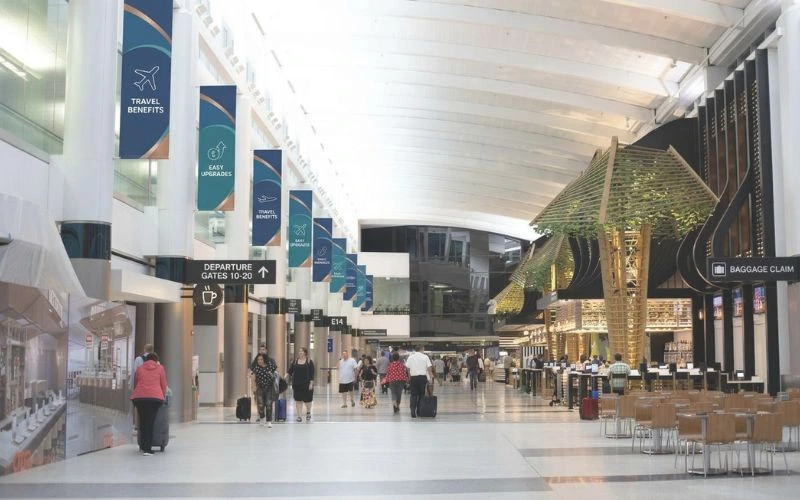
IAH puts a strong emphasis on Houston-based food brands, with local operators like Pappasitos, Landry's, El Real Tex-Mex, Hugo's, and Cru Wine Bar operating alongside national chains. Terminal C South, which opened as part of the airport's modernization, houses a large share of the sit-down restaurant options, including Ember Steakhouse, Kaufman's Tavern, and a curated group of Texas chef concepts.
Terminal E and Terminal D also carry premium dining, with wine bars, seafood counters, and grab-and-go stations serving both connecting passengers and international arrivals. Coffee options include Starbucks locations in nearly every terminal, plus regional favorites like local Texas roasters that rotate through concession contracts. For quick meals before boarding, Terminals A and B have the strongest fast-casual selection, with breakfast tacos, burger counters, and salad bars.
The IAH mobile ordering system lets passengers order and pay for food from their phone and pick up the order at the counter, cutting wait time significantly during peak hours. Nearly every terminal has vending machines with cold drinks and packaged snacks for passengers who arrive at gates outside restaurant hours.
Shops and Retail Inside George Bush Intercontinental
Retail inside IAH runs the standard airport range plus a strong duty free presence in Terminals D and E for international departures. Newsstands, tech accessory stores, luxury goods boutiques, and Texas souvenir shops are distributed across each terminal, with the widest selection concentrated in the central hub of Terminal C South and along the Terminal E concourse.
Duty free operations in Terminals D and E include liquor, tobacco, perfume, cosmetics, and select luxury brands, with pickup-at-gate service available for passengers who prefer not to carry purchases through connections. Book Buyers and Hudson News locations serve reading material and travel essentials, while InMotion and Brookstone-style tech stores handle chargers, headphones, and last-minute travel gadgets.
For Houston-themed gifts, the Texas Bookstore and Space City Souvenirs shops carry local sports team merchandise, Texas-branded apparel, and books about the state's history and food culture. Passengers looking for higher-end shopping typically find the widest selection near the Polaris Lounge area in Terminal E.
TSA PreCheck, CLEAR and Security Wait Times at IAH
TSA operates security checkpoints at each terminal at IAH, with dedicated PreCheck lanes in Terminals A, B, C, D, and E. CLEAR is available at Terminals A, B, C, and E, though not all checkpoints operate CLEAR during off-peak hours. Standard TSA lanes typically show wait times of 15 to 30 minutes during peak morning departures between 5 a.m. and 8 a.m. and evening peaks between 3 p.m. and 6 p.m.
TSA PreCheck lanes at IAH average 5 to 10 minutes during the same peak windows, and CLEAR members often move through in under 5 minutes. Global Entry members clearing international arrivals benefit from expedited kiosks in the FIS halls at Terminals D and E, cutting typical customs and immigration processing from 30 to 45 minutes down to under 15 minutes on most flights.
The MyTSA app and the FAA's airport information system publish rolling wait time estimates, though real-time data varies. Arriving 90 minutes before a domestic departure and 3 hours before an international departure remains the standard planning window at IAH, and passengers checking bags should add 15 minutes to those windows.
How to Get to IAH From Downtown Houston and Nearby Cities
Driving distance and travel time to IAH vary considerably depending on origin, time of day, and whether toll roads are used. Downtown Houston to IAH by Interstate 45 North takes 25 to 40 minutes off-peak and 45 to 70 minutes during rush hour. The Hardy Toll Road offers a faster alternative from Midtown, Downtown, and East Downtown, cutting 5 to 15 minutes off the drive but adding a toll of about $3 to $6 one way.
The Galleria area, River Oaks, and Uptown Houston travelers usually take Beltway 8 East across to IAH, running 30 to 50 minutes depending on the time of day. Sugar Land and Missouri City passengers use Beltway 8 North with Highway 59 as a fallback, and the drive averages 45 to 60 minutes off-peak. The Woodlands, Spring, and Kingwood are north of IAH and reach the terminals in 20 to 35 minutes on I-45 South or U.S. 59 South. Katy and West Houston travelers usually use I-10 East to Beltway 8 North, and the trip runs 45 to 70 minutes off-peak.
Estimated drive times from common Houston origins to IAH:
IAH vs HOU Which Houston Airport Is Better for Your Flight
IAH is the correct choice for international flights, long-haul domestic routes, and any United Airlines mainline service, while William P. Hobby Airport (HOU) is the better pick for Southwest Airlines domestic routes, shorter regional trips, and travelers based on Houston's south and southeast sides. Both airports are operated by the Houston Airport System but serve different traveler patterns and airline mixes.
Hobby Airport is about 10 miles southeast of Downtown Houston, roughly half the distance of IAH, which cuts drive time in half for travelers coming from Downtown, the Medical Center, Pearland, Clear Lake, or League City. Hobby is Southwest's Houston hub with a smaller footprint, faster security lines on average, and simpler navigation. IAH has more airlines, more international routes, more premium lounges, and larger terminal facilities.
| Comparison Point | IAH George Bush | HOU Hobby |
|---|---|---|
| Distance from Downtown | 23 miles north | 10 miles southeast |
| Primary airline | United Airlines | Southwest Airlines |
| International flights | Yes, 70+ destinations | Limited, mainly Latin America |
| Terminals | 5 (A through E) | 2 |
| Average TSA wait | 15 to 30 minutes | 10 to 20 minutes |
| Best for | Long-haul, international, United | Domestic Southwest, quick trips |
| Rideshare and taxi | Zoned pickup by terminal | Ground floor pickup |
For travelers with flexibility, choosing between IAH and HOU often comes down to which airline flies the destination, how much time is available before the flight, and where the traveler is coming from in the Houston metro. Companies handling frequent airport transfers like Pro Ride Limo route based on real-time traffic, so a passenger flying Southwest from The Woodlands still ends up on the correct route to Hobby without extra planning.
Ground Transportation Options From IAH to Houston

Ground transportation at IAH covers taxis, ride-shares, hotel shuttles, rental cars, public transit, and private chauffeur services. Each option pulls from a designated curbside island outside baggage claim at each terminal, and signage inside the terminal directs arriving passengers to the correct area. Ride-share pickups (Uber, Lyft) operate from separate lanes marked "TNC" at each terminal exit.
Taxis operate on flat rates set by the Houston Airport System for common destinations, with a Downtown Houston fare around $60 to $75, Galleria around $65 to $80, Medical Center around $65 to $85, and Sugar Land around $85 to $110. Ride-share pricing varies with surge factors, typically running slightly below taxi flat rates in low-demand windows and well above them during storms, conventions, or major event weekends.
Rental car counters are located in the Consolidated Rental Car Facility (CONRAC) accessed by a dedicated shuttle from each terminal, with all major brands operating on-site. METRO Bus route 102 provides low-cost public transit between IAH and Downtown Houston with connections to the Metro rail system, though the total transit time runs 60 to 90 minutes each way. Private chauffeur services offer flat-rate pricing set at booking, name-sign meet and greet at baggage claim, and vehicle assignment matched to luggage and passenger count.
How Much Does a Private Car Service From IAH to Houston Cost
A one-way private car service from IAH to Downtown Houston typically runs $85 to $135 in a luxury sedan and $135 to $195 in a luxury SUV, with the rate set at booking and covering all standard tolls, fuel surcharges, and a professional chauffeur. Meet and greet inside the terminal usually adds a modest fee, while curbside pickup is included in the base flat rate. Ride-share fares to the same destinations swing widely based on surge pricing and often land between $50 and $150 for the same trip.
Rates for common IAH transfers depend on the destination zone, vehicle class, service style (curbside or meet and greet), and any additional stops. Pro Ride Limo publishes flat rates for standard IAH transfers to Downtown Houston, the Galleria, the Texas Medical Center, and Houston suburbs, so passengers see the full price at booking instead of after the trip ends. Corporate accounts often add monthly invoicing and dedicated account managers for frequent business travelers.
| Destination | Luxury Sedan | Luxury SUV | Sprinter Van |
|---|---|---|---|
| Downtown Houston | $85 to $135 | $135 to $195 | $210 to $290 |
| The Galleria | $95 to $145 | $145 to $210 | $220 to $310 |
| Texas Medical Center | $95 to $145 | $145 to $210 | $220 to $310 |
| The Woodlands | $105 to $165 | $155 to $225 | $240 to $340 |
| Sugar Land | $135 to $185 | $185 to $250 | $270 to $370 |
| Katy | $145 to $200 | $195 to $265 | $290 to $390 |
| Galveston Cruise Terminal | $210 to $290 | $290 to $390 | $410 to $560 |
Prices are approximate ranges and vary by day, time, and specific pickup and drop-off addresses within each zone.
Houston Traffic Around IAH and Buffer Time You Actually Need
Traffic on the routes to IAH follows predictable patterns tied to Houston's rush hour cycles, and building a proper buffer into the trip is the difference between a calm arrival and a missed flight. Weekday peak traffic on I-45 North between Downtown Houston and IAH runs 7 a.m. to 9 a.m. inbound and 4 p.m. to 7 p.m. outbound, adding 20 to 40 minutes to the drive during those windows. Beltway 8 traffic peaks slightly earlier and later, with construction zones near the Sam Houston Tollway routinely creating slowdowns.
For weekday morning departures before 9 a.m., building a 90-minute buffer between pickup and check-in cutoff is a safe minimum for the Downtown-to-IAH corridor. Evening departures during the 4 p.m. to 7 p.m. window need the same buffer even from closer starting points, because Beltway 8 East and Highway 59 North both slow significantly during that stretch. Weekend and off-peak drives usually stay predictable, with 45 to 60 minutes covering the full window for most Houston zones. Pro Ride Limo's dispatch team knows which IAH lane backs up after 5 p.m., which is why pickup windows for evening departures are set earlier than the flight time alone would suggest.
Peak traffic notes for IAH-bound travel:
- Monday through Thursday mornings 7 a.m. to 9 a.m. add 25 to 40 minutes on I-45 North
- Friday afternoons after 3 p.m. add 30 to 50 minutes for anyone leaving Downtown or the Galleria
- Sunday evenings after 5 p.m. tighten during rodeo, convention, or NRG Stadium game days
- Rain events across Houston add 15 to 30 minutes regardless of the corridor
- Major convention weekends at the George R. Brown Convention Center create sustained Downtown congestion for two full days
International Arrivals at IAH Customs and Global Entry
International passengers arriving at IAH clear customs and immigration in the Federal Inspection Services (FIS) hall inside Terminal D for non-United carriers and Terminal E for United long-haul flights. Standard processing takes 30 to 60 minutes at peak arrival windows, though Global Entry members typically move through kiosks in under 10 minutes.
Terminal E's FIS hall is one of the largest customs processing facilities in the United States, handling wide-body arrivals from Frankfurt, London Heathrow, Tokyo Narita, Amsterdam Schiphol, São Paulo Guarulhos, and Sydney Kingsford Smith. After clearing customs, passengers with connecting United flights re-check bags at the transit desk inside the terminal and pass through TSA before heading to their departure gate. Passengers ending their trip in Houston exit into the Terminal E lower level arrivals hall, where curbside pickup, taxi lanes, and ride-share zones are clearly separated by signage. Meet and greet services at baggage claim are common for first-time international visitors who prefer a chauffeur waiting inside the terminal with a name sign instead of searching for a pickup lane after a long flight.
Corporate and Business Travel Through IAH

IAH's proximity to Houston's Energy Corridor, Downtown financial district, Texas Medical Center, and the Galleria business zone makes it the primary business travel gateway for the region. Fortune 500 companies with Houston headquarters or offices, including major energy firms and international oil and gas operators, generate consistent executive travel demand across United Polaris routes and international premium cabins.
Executive travelers arriving at IAH typically prioritize predictable pickup timing, discreet vehicle handling, and direct routing to hotels along Post Oak Boulevard, business campuses along the Katy Freeway, or medical facilities inside the Texas Medical Center. Pro Ride Limo runs corporate accounts with monthly invoicing, dedicated account managers, and flat-rate pricing for common routes, giving travel managers a predictable cost model. Sprinter vans handle small group travel for board meetings, roadshow itineraries, and conference logistics tied to the George R. Brown Convention Center, NRG Stadium events, or private receptions across River Oaks and Uptown. Corporate travelers connecting through IAH also benefit from United Polaris lounge access in Terminal E, private airport-side FBO facilities for private aviation, and expedited exit routes for time-sensitive meetings.
Frequently Asked Questions About IAH Airport
How far is IAH from Downtown Houston?
George Bush Intercontinental Airport is 23 miles north of Downtown Houston. The typical driving time runs 25 to 40 minutes outside peak hours and 45 to 70 minutes during weekday rush hour. Interstate 45 North and the Hardy Toll Road are the two primary routes, and the Hardy Toll Road is often 5 to 15 minutes faster because it bypasses I-45 traffic between Downtown and Beltway 8.
Which terminal does United Airlines use at IAH?
United Airlines operates from three terminals at IAH. Terminal B and Terminal C handle domestic mainline flights, Terminal E handles international long-haul flights and premium cabin service including United Polaris, and Terminal A hosts United Express regional flights. Domestic connections often use Terminals B and C interchangeably, while international connections route through Terminal E.
How much does a car service from IAH to the Energy Corridor cost?
A one-way car service from IAH to the Energy Corridor typically runs $115 to $165 in a luxury sedan and $165 to $230 in a luxury SUV. The route is roughly 30 miles via Beltway 8 East to I-10 West, taking 45 to 65 minutes depending on time of day. Flat-rate providers lock the price at booking with tolls and gratuity often included in advertised rates.
Is IAH or HOU better for international travel?
IAH is significantly better for international travel. IAH serves 70 plus international destinations across Europe, Asia, Latin America, the Middle East, and Africa through carriers like United, Lufthansa, Air France, KLM, British Airways, Emirates, Qatar Airways, ANA, and Turkish Airlines. HOU handles limited Latin American routes on Southwest and a few charter operators, with no long-haul intercontinental service.
How early should I arrive at IAH for a flight?
For domestic flights at IAH, arriving 90 minutes before departure is the standard recommendation. For international flights, plan on 3 hours before departure to allow for check-in, bag drop, TSA security, and the walk to Terminal D or E gates. Peak morning windows between 5 a.m. and 8 a.m. often require the full buffer, while mid-afternoon departures may move faster.
What is the best way to get between IAH terminals?
The Skyway automated people mover is the fastest option for connecting passengers already inside security, running between Terminals A, B, C, and E every few minutes with a 2 to 4 minute ride between stations. The TerminaLink underground subway runs pre-security between Terminals B, C, D, and E for landside passengers. For international-to-domestic connections, the Skyway is the primary route.
Does IAH have Global Entry and TSA PreCheck?
Yes, IAH operates both Global Entry and TSA PreCheck. Global Entry kiosks are located in the Federal Inspection Services halls at Terminal D and Terminal E for international arrivals, and TSA PreCheck lanes operate at every terminal. CLEAR is also available at Terminals A, B, C, and E during standard operating hours, and enrollment centers on-site can process same-day CLEAR memberships for travelers who need expedited screening before a flight.
Where do rideshare pickups happen at IAH?
Uber and Lyft pickups at IAH happen at designated TNC pickup zones on the lower curbside level of each terminal. Signage inside baggage claim directs passengers to the correct island. Drivers cannot pick up outside the marked TNC zones, and using the airport's cell phone waiting lot lets the driver stage nearby until the passenger requests pickup, cutting typical wait times to under 10 minutes on off-peak days.
Which lounges at IAH accept Priority Pass?
Priority Pass options at IAH are limited compared to other major U.S. airports. Most premium lounges including United Polaris, United Club, The Centurion Lounge, and the international carrier lounges in Terminal D operate on their own access programs. Priority Pass Select members can typically use dining credits at select participating restaurants inside the terminals, and the specific list rotates. Checking the Priority Pass app before travel confirms current participation.
How does customs work for international arrivals at IAH?
International arrivals at IAH clear customs and immigration in the Federal Inspection Services hall inside their arrival terminal, which is Terminal D for non-United carriers and Terminal E for United flights. Global Entry members use dedicated kiosks and typically clear in under 10 minutes. Standard processing runs 30 to 60 minutes at peak arrival windows. Passengers connecting to domestic United flights re-check bags after customs and pass through TSA again before heading to their gate.
Final Notes for Anyone Flying Through IAH
George Bush Intercontinental is a large, busy, and occasionally confusing airport for first-time visitors, but the layout follows a consistent logic once the terminal-airline mapping is clear. United mainline domestic runs through Terminals B and C, United international runs through Terminal E, non-United international runs through Terminal D, and United Express and partner regional flights use Terminal A. The Skyway inside security and the TerminaLink subway outside security cover most connection scenarios, and building a proper traffic buffer on the drive to the airport prevents almost every avoidable stress point on the day of travel.
Whether the trip is an early morning United Polaris flight to Frankfurt, a Southwest connection through Hobby, or a straightforward drive back to The Woodlands after landing, planning around the terminal, the traffic corridor, and the pickup zone is what separates a smooth IAH day from a chaotic one.